BASALT
A bass guitar emulation, from an electric guitar DI.
No bass required. And since the part comes from your actual guitar take, the low end locks tight with the riff — useful even if you already own one. Not pitch-to-MIDI, not a synth: your actual performance, an octave down and voiced like the real instrument.
VST3 · Windows · macOS to follow · free demo, mute-limited until activated
Real bass vs. Basalt — judge for yourself
Same mix, level-matched. One version has a genuinely tracked bass guitar; in the other, the bass is an electric guitar DI through Basalt. Switch instantly without losing your place and hear how it holds up next to a real bass — then the mix with no bass at all. (Weighing all your options first? We wrote up every way to get a bass track without a bass, honest pros and cons included.)
A/B demo · switching keeps your place
No bass guitar in this one. The bass is an electric guitar DI, converted by Basalt.
All versions level-matched
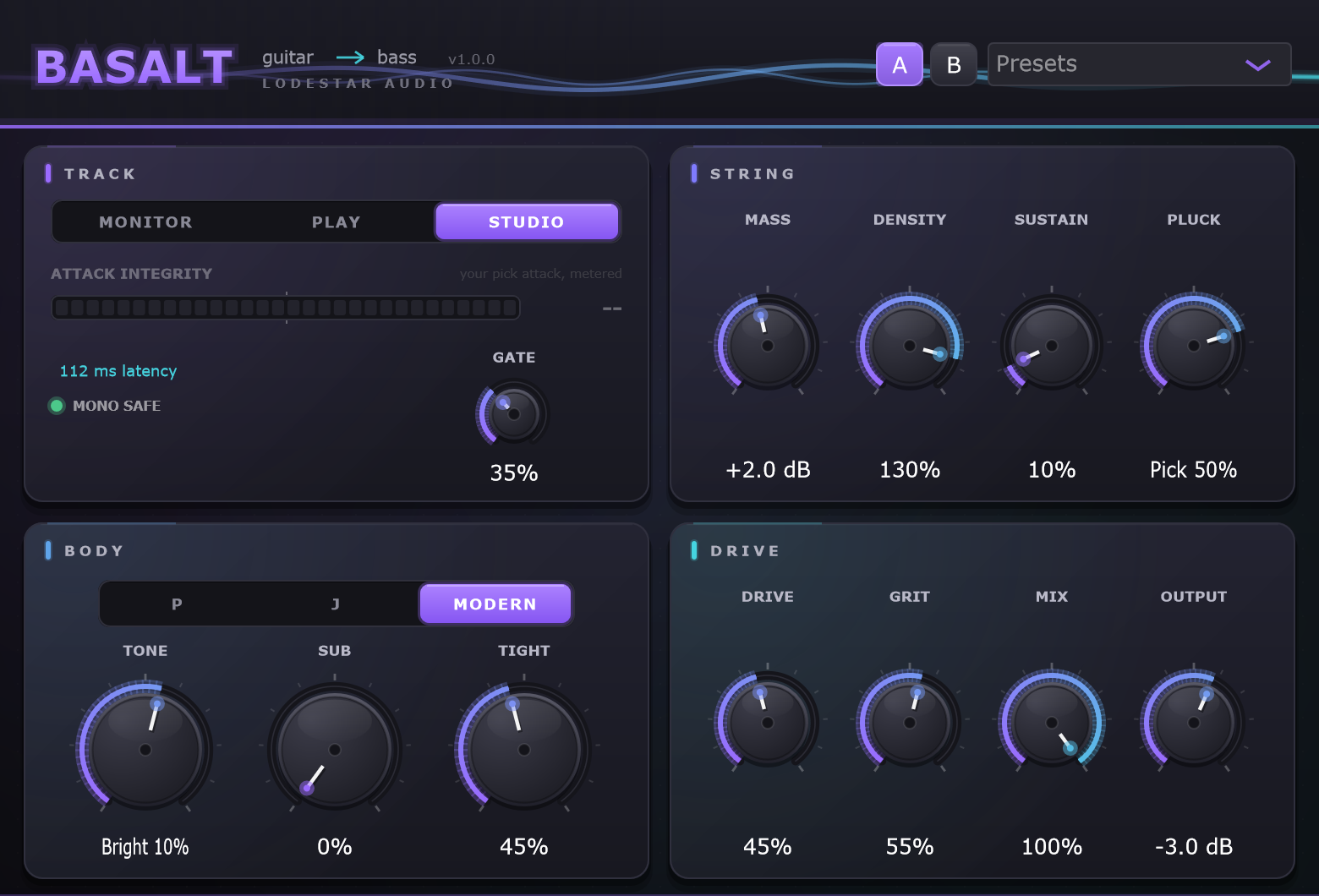
Four cards, one signal chain
Track sets the mode and latency tier. String and Body shape the converted bass — mass, density, sustain, pluck, voicing. Drive adds grit and sets the mix. The Mono-Safe lamp and Attack Integrity meter sit right on the panel, not buried in a menu.
- Monitor / Play / Studio — pick your latency tier per session
- P, J, and Modern voicings, tuned by ear against a real bass
- A/B slots, presets, and a resizable window
Your playing, an octave down
Basalt shifts the actual signal with a time-domain pitch engine — not pitch-to-MIDI, not samples, not a synth. Bass lines are almost always monophonic, which is exactly what it converts cleanly, with none of the digital hash a spectral shifter leaves behind.
The known failure of every octave pedal is the smeared attack. An octave-down always softens the transient a little — that's physics — but because Basalt works in the time domain, replaying your waveform rather than rebuilding it from a spectral transform, far more of your pick attack survives: measured at nearly double what the usual DIY pitch-shift chain keeps. The pick still reads, instead of turning to mush.
Sounds like a bass, not a pitch-shifter
No pitch-shifter wobble. The tell of every octave trick is the warble on sustained and vibrato notes. Basalt's time-domain engine tracks ~4× steadier than an ordinary spectral shifter — and keeps far more of your pick attack, too. Both metered on the panel.
- Time-domain pitch engine — clean, no spectral hash
- Far more pick attack than any octave pedal
- Three modes — Monitor / Play / Studio
- Honest latency, printed on the panel
- Mono-solid low end by construction
- Built for drop tunings — 7- and 8-string in
Mode · latency budget
Full-quality conversion for mixdown — the cleanest result, latency-compensated by your DAW.
- Latency
- 112 ms
- Engine
- Time-domain core + sub octave
- CPU
- moderate
Vibrato stability · measured
Per-band pitch wobble on a vibrato note (dB); an ordinary spectral shifter is the Signalsmith engine we A/B'd against — it wobbles where Basalt stays put.
Attack integrity · measured (secondary)
Onset sharpness, output ÷ input, across the drop-C corpus — longer is more attack kept. DIY chain = pitch −12, compression, low-pass — the workaround Basalt replaces.
Get Basalt
One price, pay once, free updates for life. Hear the demo above first if you like.